
Methodology
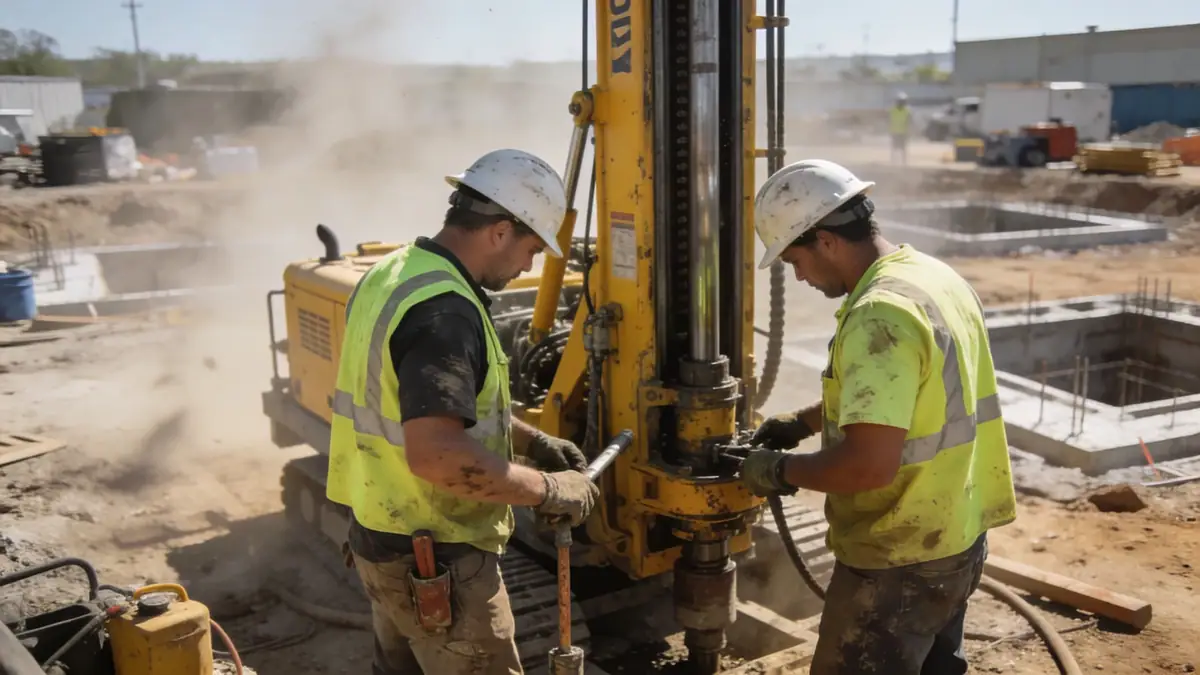
Our methodology for geotechnical engineering in Irving begins with a thorough review of existing geologic maps and boring logs to identify site-specific conditions. We then conduct field investigations including spt boring in accordance with ASTM D1586 to obtain soil samples and measure penetration resistance. Laboratory testing on recovered samples follows ASTM standards to classify soils and determine engineering properties such as strength, compressibility, and hydraulic conductivity. For seismic design, we evaluate site class per ASCE 7 using shear wave velocity measurements. This integrated approach ensures reliable recommendations for foundations, retaining walls, and slope stability in Irving.
Reference Technical Parameters
| Parameter | Reference Value |
|---|---|
| Predominant soil type | Clay (vertisol) over chalk/shale bedrock |
| Maximum seismic acceleration (PGA) | 0.10g (ASCE 7 Site Class C) |
| Typical groundwater level | 3–8 m below ground surface |
| Bedrock depth | 5–20 m (Austin Chalk) |
| Typical N60 range (SPT) | 5–25 blows/ft in clay; >50 in chalk |
Local Considerations — Irving
Irving's geology is dominated by expansive clay soils (Vertisols) overlying the Austin Chalk, which can cause significant volume changes with moisture variation. Shallow groundwater, typically 3–8 m deep, may impact excavations and foundation design. The region experiences low seismic hazard, with a design PGA of 0.10g per ASCE 7. However, local faulting near the Balcones Escarpment requires site-specific seismic evaluation for critical structures. Our team integrates these factors when providing slope stability analysis for the many developments along the Trinity River corridor. Understanding the variability between older alluvial deposits near the river and the more uniform chalk uplands is essential for cost-effective design.
Request a Quote
Our team reviews your project and issues an initial report at no cost.
Or write us directly at [email protected]
Services in Irving
Applicable Standards
- ASTM D1586 – Standard Test Method for Standard Penetration Test (SPT)
- ASCE 7 – Minimum Design Loads for Buildings and Other Structures (Seismic)
- International Building Code (IBC) – Adopted by Irving
- ASTM D2487 – Standard Practice for Classification of Soils for Engineering Purposes (Unified Soil Classification System)
Frequently Asked Questions
What types of soil are commonly found in Irving?
Irving predominantly has expansive clay soils derived from the Eagle Ford Shale and Austin Chalk formations. These vertisols shrink and swell with moisture changes, requiring special foundation design considerations such as drilled piers or post-tensioned slabs.
Are seismic studies required for construction in Irving?
Yes, per the International Building Code and ASCE 7, geotechnical investigations must evaluate seismic site class based on shear wave velocity or SPT N-values. Irving is in Seismic Design Category B, with a PGA of 0.10g, but site-specific analysis is recommended for critical facilities.
Do I need a geotechnical study for a residential project in Irving?
While not always mandatory, a geotechnical study is strongly advised for homes on expansive soils to mitigate differential movement. Many local lenders and engineers require soil testing to design appropriate foundations, reducing long-term repair costs.