Methodology

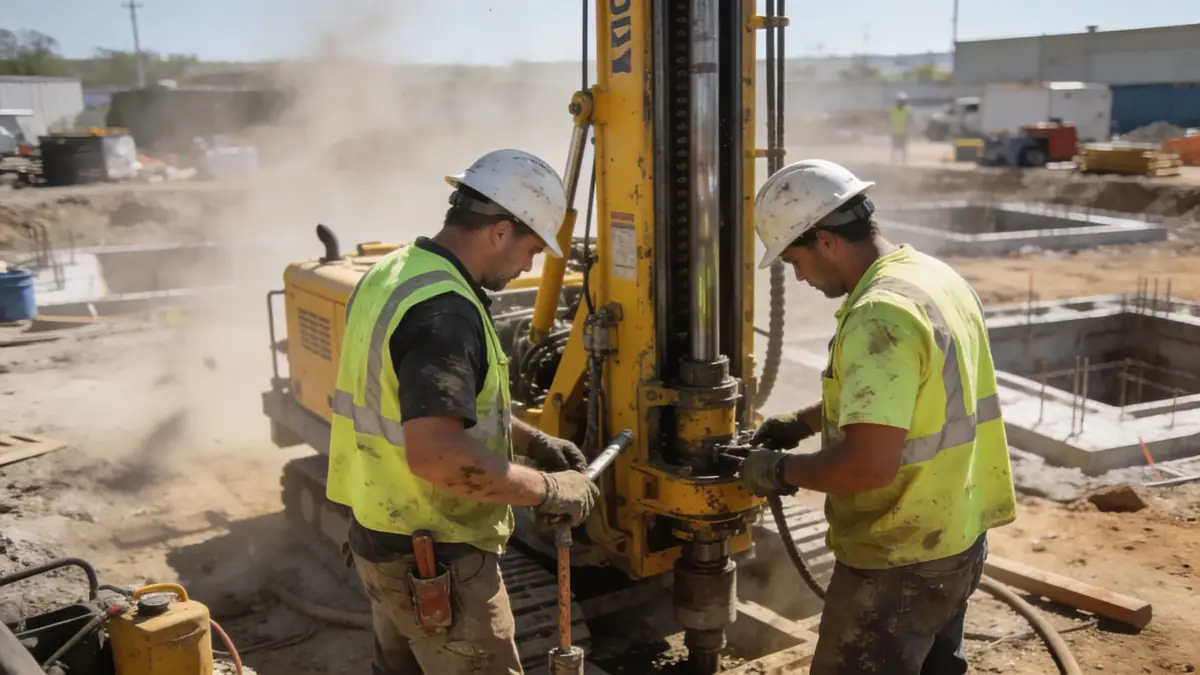
Our methodology for geotechnical engineering in Moreno Valley begins with a thorough review of existing geological maps and seismic hazard data. We then conduct subsurface investigations using standard penetration testing (SPT) per ASTM D1586, with borings typically advanced to depths of 10–15 meters for residential structures and up to 30 meters for commercial projects. Soil samples are retrieved for laboratory classification, including grain size analysis and Atterberg limits. Groundwater levels are monitored during drilling and through standpipe piezometers. Our approach integrates site-specific seismic design parameters per ASCE 7, ensuring foundations are designed to withstand the region's moderate to high seismicity. For detailed exploration methods, see our spt boring services.
Reference Technical Parameters
| Parameter | Reference Value |
|---|---|
| Predominant soil type | Silty clay and clayey sand (CL, SC) |
| Maximum seismic acceleration (PGA) | 0.4g (for 2% in 50 years) |
| Typical groundwater level | 5–10 m below ground surface (variable) |
| Bedrock depth | 50–100 m (deep alluvium) |
| Typical N60 range | 5–30 blows per foot (variable) |
Local Considerations — Moreno Valley
Moreno Valley's subsurface is dominated by alluvial fan deposits from the San Bernardino Mountains, with variable clay and sand layers. Shallow soils often exhibit low N-values (5–15), requiring deeper foundations or ground improvement for heavy loads. Seismic hazards are significant: the region has a peak ground acceleration (PGA) of 0.4g, necessitating site-specific response analysis per ASCE 7. Liquefaction potential is low due to deep groundwater, but lateral spreading near drainage channels may occur. In northern areas (e.g., near Sunnymead Ranch), older alluvium with cemented layers provides better bearing capacity. Our team integrates these factors into every project. For advanced laboratory testing, visit our soil mechanics laboratory page.
Request a Quote
Our team reviews your project and issues an initial report at no cost.
Or write us directly at [email protected]
Services in Moreno Valley
Applicable Standards
- ASTM D1586 (Standard Penetration Test)
- ASCE 7-22 (Minimum Design Loads for Buildings and Other Structures)
- California Building Code (CBC) Chapter 18
- IBC 2021 (International Building Code)
Frequently Asked Questions
What are the typical soil conditions in Moreno Valley?
Soils are predominantly alluvial silty clays and clayey sands, with occasional gravel lenses. N60 values range from 5 to 30, and groundwater is typically 5–10 m deep. These conditions require careful evaluation for foundation design.
How does seismic activity affect foundation design in Moreno Valley?
Moreno Valley is in a high seismic zone with a PGA of 0.4g. Design must account for site amplification and potential liquefaction. Our geotechnical reports provide site-specific spectral accelerations per ASCE 7 to ensure code-compliant foundations.
Is a geotechnical study mandatory for new construction in Moreno Valley?
Yes, the California Building Code requires a geotechnical investigation for most new structures. Local jurisdictions may have additional requirements. Our reports satisfy all regulatory standards and help avoid costly foundation failures.