
Methodology
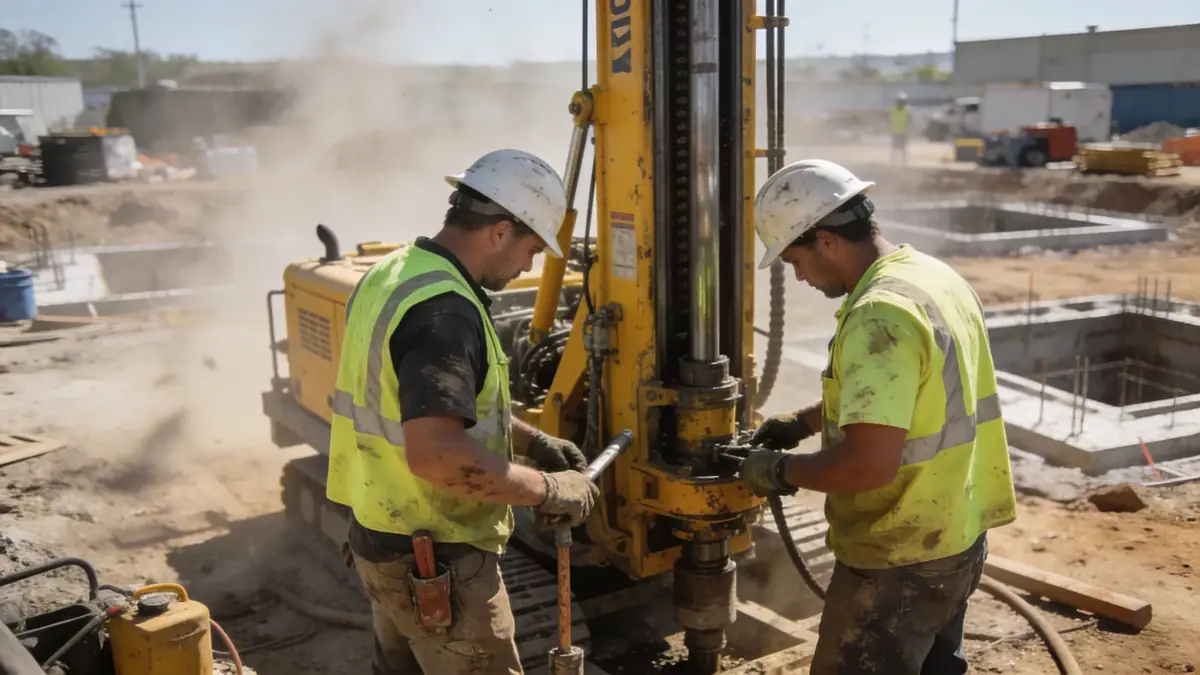
Our methodology for geotechnical engineering in Shreveport begins with a detailed review of geological maps and historical data to characterize subsurface conditions. We conduct field investigations using standard penetration testing (SPT) per ASTM D1586, with borings typically advanced to depths of 15–25 meters to capture the full soil profile. Samples are collected at 1.5-meter intervals for laboratory analysis, including grain size distribution and Atterberg limits. For projects requiring high-resolution data, we employ cone penetration testing (CPT) to obtain continuous profiles of soil behavior. Our approach integrates these results into site-specific models, allowing us to evaluate bearing capacity, settlement, and liquefaction potential under seismic loading.
Reference Technical Parameters
| Parameter | Reference Value |
|---|---|
| Predominant soil type | Silty clay and sand (alluvial deposits) |
| Maximum seismic acceleration (PGA) | 0.15g (ASCE 7-16, Site Class D) |
| Typical groundwater level | 3–6 meters below ground surface |
| Bedrock depth | 30–60 meters (Tertiary sediments) |
| Typical N60 range | 5–15 blows/0.3m (soft clays to medium sands) |
Local Considerations — Shreveport
Shreveport's geology is dominated by Quaternary alluvium of the Red River, with interbedded clays, silts, and sands. Groundwater is typically shallow, requiring dewatering considerations for excavations. The region falls under ASCE 7 Seismic Design Category B, with peak ground accelerations up to 0.15g, necessitating liquefaction assessments in loose saturated sands. Older neighborhoods near the river may have uncontrolled fill, while newer developments on Pleistocene terraces offer more competent soils. Typical projects include residential subdivisions and commercial plazas, where our team provides tailored recommendations for foundation design, referencing our geotechnical engineering in Houston hub for regional best practices.
Request a Quote
Our team reviews your project and issues an initial report at no cost.
Or write us directly at [email protected]
Services in Shreveport
Applicable Standards
- ASTM D1586 (Standard Penetration Test)
- ASCE 7-16 (Minimum Design Loads and Associated Criteria for Buildings)
- IBC 2021 (International Building Code)
- Louisiana State Uniform Construction Code
Frequently Asked Questions
What soil types are common in Shreveport?
Shreveport's near-surface soils are primarily alluvial deposits from the Red River, consisting of silty clays, sands, and occasional gravel layers. These soils are often soft to medium stiff, with N60 values ranging from 5 to 15 blows per 0.3 meters, requiring careful foundation design to control settlement.
Are geotechnical studies mandatory for construction in Shreveport?
Yes, the Louisiana State Uniform Construction Code requires a geotechnical investigation for most commercial and multi-family residential projects. Single-family homes may be exempt, but a study is strongly recommended to address variable soil conditions, especially in floodplain areas.
Does Shreveport have seismic design requirements?
Shreveport is in Seismic Design Category B per ASCE 7-16, with a maximum considered earthquake spectral response acceleration (SDS) of approximately 0.15g. While seismic loads are moderate, liquefaction potential in loose saturated sands must be evaluated for critical structures.